

Quality Timber Supplier
Timber
In general, wood that has been harvested and processed for use as building material and other uses is referred to as timber. It is a natural resource that is employed in the manufacture of paper, furniture, and other consumer items. Its strength and qualities make it a natural choice in the construction of buildings like homes, bridges, and other forms of infrastructure. Timber is a valuable resource and has a big influence on society, the economy, and the environment.
Types of Timber
We offer a variety of timber options because different woods have unique characteristics and are appropriate for different applications. Factors that can impact the selection of timber include the wood’s strength, durability, resistance to pests and decay, appearance and texture, and cost and availability.
Different types of wood also originate from various regions across the world, not just Southeast Asia, and grow in different climates which can affect their properties.
In addition, various treatments and processes can be applied to wood to enhance its properties or make it suitable for specific uses. For example, pressure treatment can make timber more resistant to rot and decay, and kiln drying can decrease its moisture content and increase its stability.
In conclusion, the wide range of timber options available enable builders and woodworkers to choose the best type of wood for their specific needs and requirements.
Solid Meranti
Wood of the Shorea species, which is indigenous to Southeast Asia, is used to make solid meranti lumber. Due to its tenacity, sturdiness, and appealing look, it is a preferred material for use in building and furniture manufacturing. Meranti is a trade group with varying colour, strength and natural durability. Identify the particular group and exposure conditions rather than assuming uniform decay resistance. It is frequently employed in the creation of furniture and other ornamental objects as well various building elements.
Kapur
Kapur comes from Dryobalanops species in the Dipterocarpaceae family. It is used for suitable construction and joinery. Natural durability varies by species, so exterior use requires careful specification rather than an assumption of superior weather resistance.
Jelutong
Dyera trees, which are located in Southeast Asia, are used to produce jelutong lumber. It is observed as soft, spongy wood with a fine, even grain that is pale in colour. Its softness and workability make Jelutong useful for carving, pattern making, toys and other suitable indoor work. It should not be presented as naturally durable exterior timber.
Mahogany
Swietenia trees, which are mostly found in Central and South America, are the source of mahogany. It is noteworthy for its rich hue of reddish-brown to dark brown and is a robust, substantial wood with a beautiful texture. Furniture, musical instruments, and other delicate goods are typically made out of mahogany. Confirm the actual species sold under the mahogany name, along with its grade, dimensions and suitability for the intended finish.
Nyatoh
Nyatoh is a trade name for several timbers in the Sapotaceae family, including Palaquium, Payena and Madhuca species. It typically has pinkish-red to reddish-brown heartwood and is used for suitable furniture and joinery. Density and durability vary; it should not be treated as a direct equivalent of teak.
Balau
A form of wood called balau timber is derived from trees of the Shorea species, which are found in the forests of Southeast Asia. Balau wood is renowned for its extreme strength, long lifespan, and resistance to rot and decay. In addition to making furniture and other ornamental objects, it is frequently employed in the construction of buildings. Balau and teak have different properties. Compare the actual grade, application and current quotation rather than assuming they are interchangeable.
Keruing
A form of wood called keruing is made from Dipterocarpus trees, which are indigenous to Southeast Asia and the Indian subcontinent. It is a strong, solid wood with a coarse, interlocking grain that ranges in colour from yellow to reddish brown. Some Keruing species contain silica that can affect tool wear; machining requirements vary. It is frequently employed in naval applications and truck decks.
Chengal
Neobalanocarpus trees are used to produce chengal lumber, a form of wood. It is a strong, heavy wood with a coarse, interlocking grain. Chengal wood is renowned for being extremely durable and strong. Chengal is used where its documented durability and strength suit the project. Availability and price should be confirmed rather than assumed relative to teak.
Clear Pine
Clear pine timber is pine that is of a high standard and devoid of knots or other flaws. Pine is a soft, light-weight wood with a straight grain and a light-yellow colour. It is frequently employed in building, creating furniture, and other woodworking tasks. Because it is more visually beautiful and simpler to work with, clear pine is usually more costly than pine wood with knots or other flaws. It is cherished for its smooth, even look and frequently employed for ornamental purposes, such as trim work or panelling.


Uses
Timber is a highly valued material that has been used directly in construction, in the production of paper, in the design of furniture, and as a significant fuel source. Timber is frequently utilised for many purposes because of its sturdiness, adaptability, and aesthetic appeal. Utilising timber offers a number of advantages, including being a renewable material when forests are managed responsibly and offering a variety of natural appearances. Environmental performance depends on sourcing, processing, transport, service life and end-of-life treatment.
Construction
The most important application of timber is in the construction sector. Timber can offer a useful strength-to-weight ratio in appropriate construction systems. A project-specific design must establish loads, connections, moisture protection and fire requirements. Cost and environmental comparisons depend on the complete system.
Furniture-making
Timber is a beloved choice when it comes to crafting furniture, such as tables, chairs, and cabinetry. Its versatility allows for a wide range of styles and aesthetics, as various types of wood can be utilised to achieve distinct looks. Furthermore, the finishing and staining processes offer opportunities to create unique and desired effects.
Carpentry and woodworking
Timber is a fundamental material in the world of carpentry and woodworking, finding its application in a diverse array of projects. From the construction of doors, windows, and various building components to the creation of decorative elements like moldings and trim work, timber plays a vital role in bringing structures to life and adding aesthetic charm.


Properties
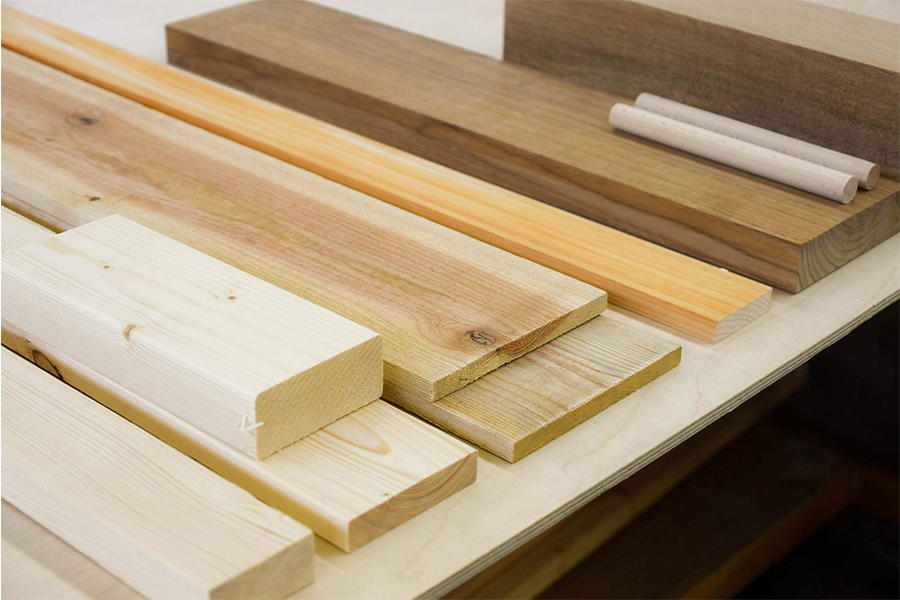
After stone masonry, timber is the oldest material still in use by humans for construction. Despite having a complicated chemical makeup, wood possesses remarkable qualities that make it suitable for human usage. It is easily machinable, readily accessible, and adaptable to fabrication into a limitless number of sizes and forms utilising basic on-site construction methods. Here are some fundamental characteristics of wood:
Renewability
Timber can be renewed through forest growth and responsible management, but renewal times vary. Wood stores carbon during its service life. Sustainable-sourcing and carbon claims need evidence for the actual supply chain.
Strength and durability
Timber strength depends on species, grade, moisture content and loading direction. Correctly designed and maintained timber can give long service. Structural comparisons with steel or concrete require defined test conditions and cannot be expressed as a universal percentage.
Versatility
The adaptability of design shapes and finishes is one of timber’s finest qualities. This adaptability also includes the simplicity with which existing structures may be expanded or altered to accommodate shifting needs. Easy-to-work-with, adaptable timber allows architects and construction designers creative latitude, giving homeowners a variety of design options. Material selection should reflect the actual project requirements. It can be used to build the houses we love, the structures we admire, as well as warehouses, office buildings, and other structures. The wood frame construction technology offers architects freedom in terms of interior arrangement and outside design.
Specify Timber by Species, Grade and Finished Size
A trade name is only the starting point for choosing timber. The Malaysian Timber Council species reference distinguishes species groups and their properties. It identifies Kapur as Dryobalanops and Nyatoh as timbers from the Sapotaceae family. Durability can vary within a trade group.
Provide the finished thickness, width and length as well as the quantity. State whether the timber will be visible, painted, clear-finished or concealed. Rough-sawn and finished dimensions may differ, so label the drawing clearly and confirm the supplied condition before allowing for machining.
For exterior components, describe rain exposure, drainage and any ground contact. The appropriate species and protection depend on these conditions. Structural uses also require the necessary grade and design. Compare finger-jointed timber where a manufactured length is appropriate, or plywood when the project needs a sheet material. Ask about current availability for the specific size rather than assuming every species is stocked in every section.
Timber Numbers: Volume, Finished Sections and Moisture
Timber quantities become easier to compare when length and section are converted to volume. The examples below use hypothetical rectangular pieces; they are not stocked sizes, species densities or grading values. Multiply thickness, width and length in metres to obtain cubic metres, and keep the finished section separate from the rough section when discussing a quotation.
Volume depends on the finished section
At the same 3,000 mm length, the rough example volume is 0.00375 m³ per piece and the finished volume is 0.003102 m³. Shapes, defects and end trimming can reduce usable yield further.
Illustrative calculation inputs; diagram not to scale.
| Piece schedule | Volume per piece | Total volume |
|---|---|---|
| 25 × 50 × 3,000 mm; 20 pieces | 0.025 × 0.050 × 3.000 = 0.00375 m³ | 0.075 m³ |
| 50 × 100 × 2,400 mm; 10 pieces | 0.050 × 0.100 × 2.400 = 0.012 m³ | 0.120 m³ |
| 22 × 47 × 3,000 mm; 20 finished pieces | 0.022 × 0.047 × 3.000 = 0.003102 m³ | 0.06204 m³ |
Rough Volume Is Not Finished Yield
Machining an example 25 × 50 mm section to 22 × 47 mm reduces its rectangular cross-sectional area by approximately 17.3%, with length unchanged. This describes geometry, not a guaranteed processing yield: defects, end trimming and shaped profiles can remove more material. If the first schedule had an assumed density of 600 kg/m³, its calculated mass would be 0.075 × 600 = 45 kg. Different species and moisture conditions can change the actual mass substantially.
Moisture content uses oven-dry mass
The 12 g mass difference is divided by the 100 g oven-dry mass. This explains the percentage calculation and does not set a target moisture content for supplied timber.
Illustrative calculation inputs; diagram not to scale.
Understand a Moisture Percentage
Wood moisture content is commonly expressed relative to oven-dry mass. A sample weighing 112 g before drying and 100 g oven-dry has (112 − 100) ÷ 100 × 100 = 12% moisture content. This illustrates the definition, not a universal target for timber supplied in Singapore. A meter reading must be interpreted for its instrument, species and measuring conditions. Do not derive a movement allowance from moisture percentage alone.
The USDA Wood Handbook moisture chapter explains the relationship between water content and wood properties. Specify the intended location, drying condition and species alongside the finished dimensions. Structural grades and allowable loads require appropriate documentation; calculated volume does not establish strength. Compare finger-jointed lengths for suitable manufactured-length applications. For procurement, agree whether billing is by piece, running metre or volume and whether the dimensions are nominal, rough or finished; the same piece count can represent different usable quantities.
Frequently Asked Questions
What types of timber do you supply? | We supply solid meranti, kapur, jelutong, mahogany, nyatoh, balau, keruing, chengal, and clear pine, among others. |
Which timber is best for decking? | Choose against the actual species, grade, exposure and design. Kapur durability varies, so it should not be assumed suitable for every decking project. |
Are your timber species durable against rot and decay? | Natural durability varies between and within timber groups. Identify the actual species and exposure conditions before choosing protection or an exterior use. |
Is timber a sustainable building material? | Timber can be renewable when forests are responsibly managed. Environmental performance depends on sourcing, processing, transport, service life and end-of-life treatment. |
What is timber commonly used for? | It's used in construction, furniture-making, and carpentry, from framing and doors to decorative trim work. |